Wireless Condition Monitoring Optimizes MTBR


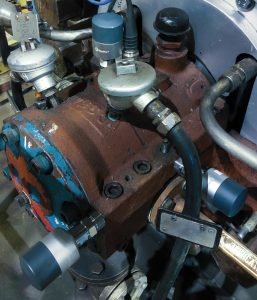
Working in partnership with the plant condition monitoring team, the PIEs installed a total of nine SDOF (Single Degree of Freedom) wireless vibration sensors on the pump and drive.

Alerts, advanced analysis, and automated reporting help to improve maintenance strategies and critical asset decision-making.

A power plant in Southeast Australia had recently experienced chronic high vibration amplitudes on a critical multistage boiler feed water pump. Given the criticality of the pump and the risks associated with catastrophic pump failure, the power plant contacted Hydro Australia for support.

In collaboration with Hydro, Inc.’s wireless condition monitoring team, Hydro Australia was able to provide the power plant with a significantly improved IIoT-based monitoring system. This would assist the plant by closely monitoring the status of its asset, making the best possible decisions for equipment maintenance, and ensuring equipment availability

Source: https://www.pumpindustry.com.au/wireless-condition-monitoring-optimises-mean-time-between-repair
Root Cause Analysis Uncovers Casting Defects

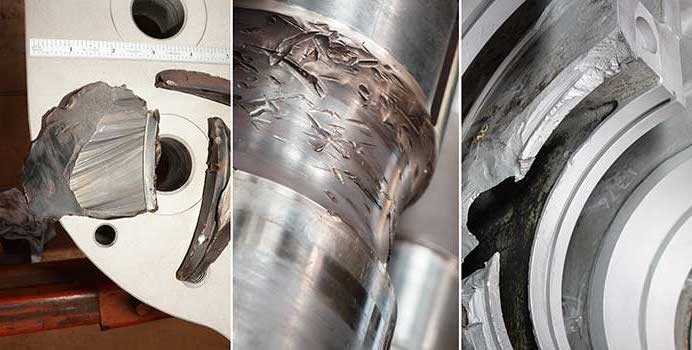
Efficiency and reliability are at the forefront of a successful pumping system. As such, unplanned outages can be a detrimental disturbance to the overall operation. In this case, the end user’s high pressure multistage  BB5 barrel pump was experiencing severe vibration, unstable performance, and failure in the field leading to unit shutdown.

This particular unit, used in boiler feedwater operations, is critical to the plant’s uptime and throughput. Furthermore, continued failures can cause growing costs due to inevitable maintenance and repairs, often overlooking a long term solution. With each unplanned outage, the plant could face a significant loss in capital.

Previously, the pump had been running for six months before experiencing catastrophic failure, requiring a shutdown and removal for further analysis. Initially, the unit’s damaged components were repaired by welding, and the volute was reassembled and installed for use. Upon its installation, the power plant placed the unit back into service but encountered a second emergency shutdown after two months in operation.

Video: https://vimeo.com/362808909

Source: https://www.pumpsandsystems.com/root-cause-analysis-uncovers-casting-defects-critical-boiler-feedwater-unit

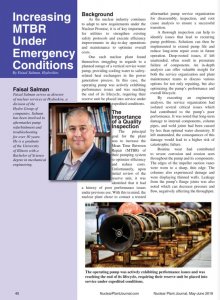
Increasing MTBR Under Emergency Conditions

increasing mtbr under emergency conidtionsAs the nuclear industry continues to adapt to new requirements under the Nuclear Promise, it is of key importance for utilities to strengthen existing safety protocols and execute efficiency improvements in day-to-day operations and maintenance to optimize overall costs.

One such nuclear plant found themselves  struggling in regards to a planned outage of a vertical service water pump, providing cooling water to safety-related heat exchangers in the power generation process. In this case, the operating pump was actively exhibiting performance issues and was reaching the end of its lifecycle, requiring their reserve unit be placed into service under expedited conditions.

The principle goal for the plant was increasing Mean Time Before Repair (MTBR) of their pump system to optimize efficiency and reduce costs. Unfortunately, upon initial review of the reserve unit, it was identified that it had a history of poor performance issues under previous use.

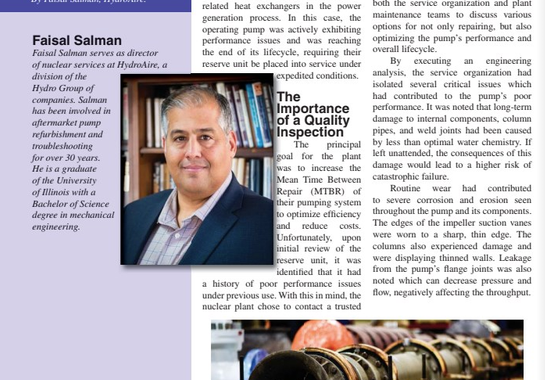
Authored by Faisal Salman.
Source: nuclearplantjournal.com

HydroTex Deer Park Service Center Relocating to La Porte, TX

The new 33,000 square building in La Porte, Texas.

HydroTex, a subsidiary of Hydro, Inc., announces the move of its Deer Park operation to a new 33,000 square foot building in La Porte, TX.

The new service center will offer expanded capacity for analysis, engineering, rebuilding and repair services for pump systems and rotating equipment as well as climate controlled storage of pumps and parts.

Located near the busy Houston Ship Channel, the new facility is ideally situated to serve the needs of surrounding industries using pumping equipment of any capacity. To learn more about the new facility or to schedule a shop visit, please contact HydroTex.


Source: pumpsandsystems.com

Middle East Power Plant Demonstrates the Advantages of Pump Health Audits

With the help of a field evaluation, plant managers avoided unnecessary pump repairs.

Written by: Gary Dyson & Thomas Arakal
Publisher: Pumps & Systems / December 2016


A decade-old, 1,000-megawatt (MW) combined cycle power plant in the Middle East called an equipment repair and engineering company to conduct a pump health audit. Given the age of the plant and the fact that none of the pumps had undergone a major overhaul, plant personnel asked the engineering firm to determine which pumps should be pulled for repair at the next scheduled outage. The equipment consisted of six condensate extraction pumps and six boiler feed pumps.

Leaving the production process undisturbed, the field pump health evaluation team conducted a non-invasive pump study. Flow, pressure, vibration, power consumption, temperature and other data were collected for all the pumps in various regimes of operation. A team of engineers analyzed and compared the results of the measurements to the original design parameters. The study’s conclusions and engineering recommendations were published.

Continue reading