The Dangers of Operating Pumps at Low Capacity


Operating at low flow places the machine under a great amount of duress. It is always wise to have a mental picture of what is happening within the passages of the machine to understand why this is the case.

The days have long passed where pump vibrations were viewed as a matter of mechanical balance. Now, we recognize that even if the pump had perfect mechanical balance, it would still exhibit vibrations.

The intensity of this remnant vibration turns out to be flow related with its minimum level being at or around best efficiency point (BEP).

Source: https://www.pumpsandsystems.com/dangers-operating-pumps-low-capacity

Wireless Condition Monitoring Optimizes MTBR


Working in partnership with the plant condition monitoring team, the PIEs installed a total of nine SDOF (Single Degree of Freedom) wireless vibration sensors on the pump and drive.

Alerts, advanced analysis, and automated reporting help to improve maintenance strategies and critical asset decision-making.

A power plant in Southeast Australia had recently experienced chronic high vibration amplitudes on a critical multistage boiler feed water pump. Given the criticality of the pump and the risks associated with catastrophic pump failure, the power plant contacted Hydro Australia for support.

In collaboration with Hydro, Inc.’s wireless condition monitoring team, Hydro Australia was able to provide the power plant with a significantly improved IIoT-based monitoring system. This would assist the plant by closely monitoring the status of its asset, making the best possible decisions for equipment maintenance, and ensuring equipment availability

Source: https://www.pumpindustry.com.au/wireless-condition-monitoring-optimises-mean-time-between-repair

Engineering a Long-Term Solution

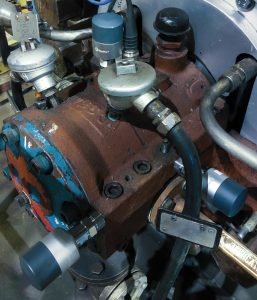
Figure 1. The pump as received

Many pumps in operation today were designed and manufactured decades ago. As plants require increased capacity, pump systems are expected to meet these higher process flow demands. Without an impeller rerate or change in speed, this increased capacity can be achieved in one of two ways. The individual pumps can supply more flow to the system, resulting in operation out on the pump curve. Alternatively, capacity can be increased by operating more pumps in parallel; in this case operation is pushed back on the curve, as operating another pump in parallel requires less flow from each individual pump to meet total system demand.

Either operational change results in a move away from the pump best efficiency point (BEP). As a result, the original designs and hydraulic characteristics no longer effectively meet plant requirements and detrimental effects from hydraulic instability can occur.

By way of example, this article will discuss a fertilizer plant in the Gulf of Mexico that had a boiler feedwater pump unit that was experiencing performance problems after a significant plant expansion project. Unfortunately, it was not the first time this particular unit had experienced a loss of capacity; the pump had been in operation only 18 months prior to the current issue.


Asset Monitoring Improves Reliability & Visibility

Hydro remote condition monitoring A major pipeline transmission company found itself reconsidering the effectiveness of its maintenance strategy. The company faced a challenge: optimizing asset visibility and implementing remote condition monitoring of equipment health while avoiding a high-cost investment and installation disruptions.

This particular pipeline transfers a variety of products, ranging from gasoline to jet fuel, serving customers via pump stations and storage tanks across the United States. For this customer, it is imperative to ensure that pumping assets are efficient, reliable and safely maintained consistently. The pipeline supports the needs of more than 50 cities, thus making the pumping assets critical to the availability and overall operation.

Technology plays a vital role in day-to-day operations in supporting end user activities, ensuring strict safety regulations, optimizing maintenance and providing data on equipment health. In this case, the pipeline company wanted to significantly improve and innovate upon its current maintenance approach in two ways: by monitoring asset visibility in real-time and trending data for their critical pumping equipment.

Authored by Ares Panagoulias and Ken Babusiak.
Sourced: pumpsandsystems.com

Hydraulic Rerates & Pump Efficiency

During a mechanical seal replacement at a major gas plant, a reliability engineer identified that their API OH2 centrifugal pump was operating below the Minimum Continuous Stable Flow (MCSF).

In this case, Hydro Rocky Mountain partnered with HydroTex Deer Park‘s engineering team to provide the customer with an innovative solution by utilizing the existing casing and providing a redesigned impeller to optimize the overall efficiency and life cycle of the unit.

Watch as Ares Panagoulias and Glen Powell, of Hydro’s test lab, examine the historic operating conditions in regard to the pump’s best efficiency point (BEP) and provide a performance test to validate the upgrades and modifications.

Case Study: Hydraulic Rerates & Pump Efficiency from Hydro, Inc. on Vimeo.

Read the full article on World Pumps: worldpumps.com/ancillary-products/features/seal-replacement-reveals-causes-of-vibration/