The Basics of Reciprocating vs. Centrifugal Pumps

Image 1. A reciprocating pump’s fixed volume. Flow is determined by stroke, area and speed. (Images courtesy of Hydro)

Understanding the differences between these types of pumps can mean avoiding difficulties and reliability problems.

The demand for the duties that fall within the performance range of reciprocating pumps is rising. Process flows are falling while the pressures required are increasing.

Engineers are generally familiar with operating principles, performance curves and selection criteria for centrifugal pumps, but the training and knowledge around the operating principles of reciprocating pumps is not as common.

Unlike centrifugal pumps, reciprocating pumps have a stronger interaction with the system within which they sit. This is due to the pressure pulsations they generate.

If we think about any linear reciprocating motion of a piston, at some point the velocity of the piston is zero as it changes direction at the top and bottom of its stroke. This means that the pressure pulsations are much larger in a reciprocating machine than in a centrifugal machine.

Authored by Gary Dyson.
Source: pumpsandsystems.com

Asset Monitoring Improves Reliability & Visibility

Hydro remote condition monitoring A major pipeline transmission company found itself reconsidering the effectiveness of its maintenance strategy. The company faced a challenge: optimizing asset visibility and implementing remote condition monitoring of equipment health while avoiding a high-cost investment and installation disruptions.

This particular pipeline transfers a variety of products, ranging from gasoline to jet fuel, serving customers via pump stations and storage tanks across the United States. For this customer, it is imperative to ensure that pumping assets are efficient, reliable and safely maintained consistently. The pipeline supports the needs of more than 50 cities, thus making the pumping assets critical to the availability and overall operation.

Technology plays a vital role in day-to-day operations in supporting end user activities, ensuring strict safety regulations, optimizing maintenance and providing data on equipment health. In this case, the pipeline company wanted to significantly improve and innovate upon its current maintenance approach in two ways: by monitoring asset visibility in real-time and trending data for their critical pumping equipment.

Authored by Ares Panagoulias and Ken Babusiak.
Sourced: pumpsandsystems.com

Hydraulic Rerates & Pump Efficiency

During a mechanical seal replacement at a major gas plant, a reliability engineer identified that their API OH2 centrifugal pump was operating below the Minimum Continuous Stable Flow (MCSF).

In this case, Hydro Rocky Mountain partnered with HydroTex Deer Park‘s engineering team to provide the customer with an innovative solution by utilizing the existing casing and providing a redesigned impeller to optimize the overall efficiency and life cycle of the unit.

Watch as Ares Panagoulias and Glen Powell, of Hydro’s test lab, examine the historic operating conditions in regard to the pump’s best efficiency point (BEP) and provide a performance test to validate the upgrades and modifications.

Case Study: Hydraulic Rerates & Pump Efficiency from Hydro, Inc. on Vimeo.

Read the full article on World Pumps: worldpumps.com/ancillary-products/features/seal-replacement-reveals-causes-of-vibration/

Machined centrifugal pump

Maximizing Efficiency in Descaling Pumps

descale pump impeller damage

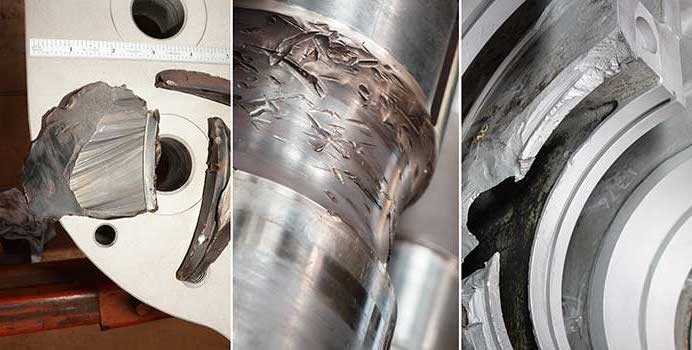
Damaged impeller showcasing severe corrosion.

A major steel plant on the East Coast had been experiencing catastrophic failures with its five-stage descaling pumps. The plant operated using three multistage axially split (BB3) pumps with two spares. All five of the pumps had a mean time between repair (MTBR) of two years. In this case, the plant water quality was considered to be less than ideal, and the entrained abrasives were a factor contributing to the repeated failures.

Poor water quality can lead to a number of pump reliability issues. When pumping fluids with abrasive material, pumps experience erosion and corrosion, and the effects can rapidly degrade both the casings and critical inner elements. While erosion and corrosion alone are not always a difficult problem to solve, it is important to have a firm understanding of the relationship between various types of erosion and corrosion and the metallurgy used in designing the pumps.

Further analysis showcased excessive clearances and inconsistencies with component fits that also contributed to pump performance degradation outside the abrasion. In order to increase the MTBR of the pumps at the plant, the aftermarket pump service provider recommended several engineered upgrades including new impellers to be manufactured using advanced mold technology, specifically addressing the surface finish and dimensional consistency.

Source: https://www.pumpsandsystems.com/maximizing-efficiency-descaling-pumps

Optimizing Reliability Through Material Upgrades

centrifugal pump test

The 14-stage boiler feedwater pump installed for testing to ensure that the performance achieves desired operating conditions.

At a combined cycle power plant, a boiler feedwater pump was experiencing problems. Dr. Gary Dyson of Hydro, Inc. and Larry White of HydroTex discuss how major cost savings were provided through engineering analysis, material upgrades and testing for validation.

A combined cycle power plant in the Pan Handle region of Texas found themselves experiencing repeated failure on one of their 14 stage boiler feedwater (BB3) pumps. The pump had recently been modified by the supplier to provide a short-term solution. This in turn reduced the mean time between failure (MTBF) of the pump, requiring continued support and further analysis.

Combined cycle plants are comprised of both gas and steam power production technologies, capable of producing up to 50% more electricity than traditional simple-cycle plants. With the ever-increasing demand for energy, this technology is becoming increasingly relevant in throughout the pump industry. As such, it is highly important that these plants operate at peak efficiency.

Originally, the stationary inserts at several locations in the pump assembly were modified in such a way that increased the likelihood of friction and galling of the stationary and rotating parts of the pump assembly. The consecutive failures experienced on site were repeatedly of the same failure mode, which strongly points toward a pump design problem.

Authored by Gary Dyson, Ares Panagoulias, Larry White, and Chris Brown.
Source: worldpumps.com